


Fire Safety Certification in Australia: What Building Owners & Managers Need to Know
Quick Summary
Fire safety certification isn’t just paperwork, it’s proof that your building’s fire protection systems are working, compliant, and ready when it matters most. This guide breaks down everything property owners, facility managers, and strata managers need to know.
Table Of Contents
In Australia, certification frameworks such as the Annual Fire Safety Statement (AFSS) in NSW and equivalent systems nationwide form the backbone of regulatory compliance, but maintaining compliance with fire safety certification can at times seem confusing.
This guide provides a simplified summary of the requirements, covering certification types, legal obligations, the latest reforms, penalties, and how to simplify the compliance process.
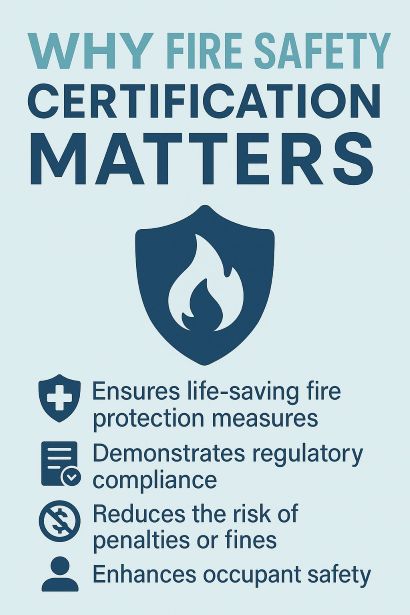
Why Fire Safety Certification Matters
Fire safety certification ensures that every essential fire safety measure, from alarms to sprinklers to fire doors, has been correctly installed, tested, and maintained.
Beyond safety, certification carries major legal, financial, and insurance implications. According to Fire & Rescue NSW’s 2023/24 Annual Report, firefighters attended 140,827 incidents, including 4,000+ building fires where inadequate fire systems were a contributing factor.
Without valid certification, property owners risk:
- Council fines exceeding $110,000 (under the Environmental Planning and Assessment Act 1979)
- Insurance claim rejections, and
- Legal liability if injury or loss occurs due to system failure
In other words: certification isn’t red tape, it’s risk protection.
Ready To Discuss Your Requirements?
Our Experts Look Forward To Hearing From You!
What Is Fire Safety Certification?
Fire safety certification is the formal verification that a building’s fire protection systems comply with Australian standards and are functioning as designed.
Depending on the jurisdiction, this may involve one or more of the following documents:
- Fire Safety Certificate (FSC): Issued when a building is newly completed or after fire safety upgrades
- Annual Fire Safety Statement (AFSS): Confirms that each fire safety measure has been inspected, tested, and maintained during the past 12 months
- Fire Safety Schedule: Lists the specific fire safety measures required for a building under local approval or development consent
Each of these documents is crucial to prove compliance under the National Construction Code (NCC) and relevant state regulations.
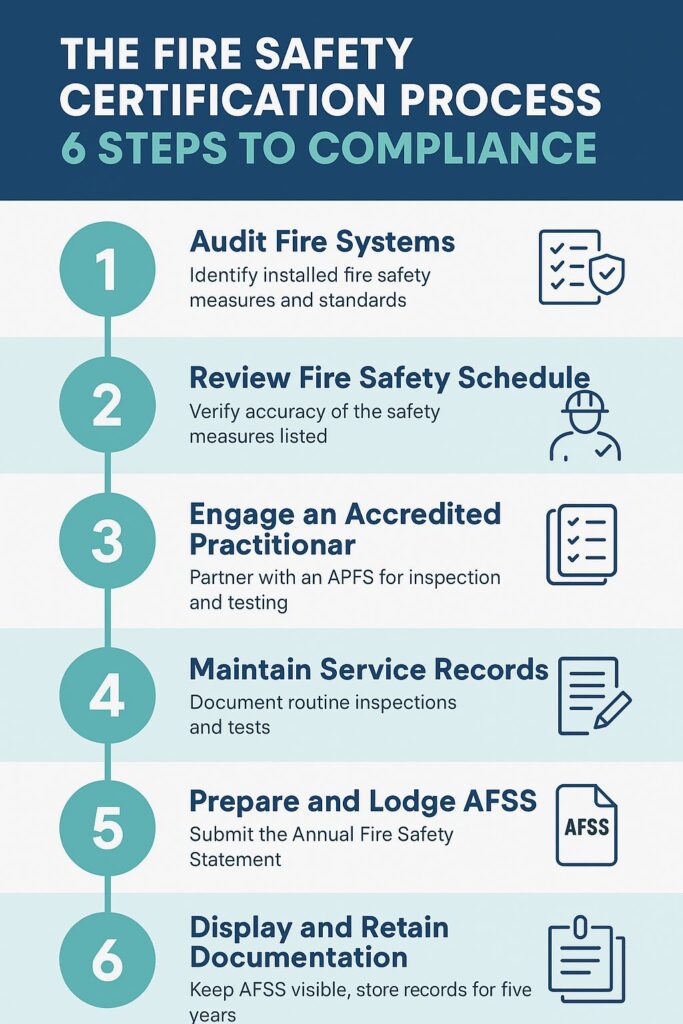
How To Streamline Fire Safety Certification
Achieving and maintaining certification doesn’t have to be overwhelming. A structured approach makes the process efficient and stress-free.
Step 1: Audit Your Current Fire Systems
Identify all installed fire safety measures, alarms, sprinklers, extinguishers, emergency lights, hydrants, doors and confirm the applicable standards.
Step 2: Review Your Fire Safety Schedule
Ensure the Fire Safety Schedule matches the building’s current configuration and use. Outdated or missing measures can invalidate certification.
Step 3: Engage an Accredited Practitioner (Fire Safety)
Partner with an FPAS-accredited company like Essential Asset & Fire for inspection, maintenance, and reporting.
Step 4: Maintain Routine Service Records
Document every inspection and test per AS 1851-2012. These logs are vital during annual audits.
Step 5: Prepare and Lodge Your AFSS
Once all measures are tested and compliant, your practitioner issues the AFSS, which must be submitted to your local council and FRNSW.
Step 6: Display and Retain Documentation
Keep a copy of your AFSS clearly visible and store all related records securely for at least five years.
The Australian Regulatory Framework
Fire safety certification in Australia operates under a multi-layered legal framework, integrating:
- The National Construction Code (NCC Volume 1 – Building Code of Australia)
- Australian Standards (AS 1851-2012, AS 2419.1-2021, AS 1670.1-2018, AS 2293.1-2018, etc.)
- State and Territory Legislation & Regulations
- Local Council Enforcement
While the NCC sets national performance requirements, each state enforces its own certification process and inspection intervals. For example, NSW uses the AFSS framework, whereas Queensland, Victoria, and Western Australia operate under different but similar certification systems.
State-by-State Requirements
| State / Territory | Key Certification Document | Legislation / Framework |
| NSW | Annual Fire Safety Statement (AFSS) | Environmental Planning & Assessment (Development Certification & Fire Safety) Regulation 2021 |
| Victoria | Essential Safety Measures (ESM) Annual Report | Building Regulations 2018 (VIC) |
| Queensland | Occupier Statement | Building Fire Safety Regulation 2008 |
| South Australia | Schedule 16 Maintenance & Certification | Development Regulations 2008 |
| Western Australia | Building Permit & Fire Safety Certificate | Building Act 2011 (WA) |
| ACT | Annual Fire Safety Maintenance Certificate | Building (General) Regulation 2008 |
| Tasmania | Maintenance of Essential Safety & Health Features | Building Regulations 2016 |
| Northern Territory | Annual Maintenance Certification | Building Regulations 1993 |
While the documents vary, the core intent is identical: verify that fire protection systems are maintained and ready to perform.
Ready To Discuss Your Requirements?
Our Experts Look Forward To Hearing From You!
Understanding The Annual Fire Safety Statement (AFSS)
In NSW where many commercial, residential, and government properties are located, the AFSS is the centrepiece of compliance.
An AFSS must be lodged annually with both the local council and Fire & Rescue NSW (FRNSW).
It confirms that:
- All essential fire safety measures have been inspected, tested, and certified by an Accredited Practitioner (Fire Safety) (APFS)
- The building meets the performance standards listed on its Fire Safety Schedule
- The statement is displayed prominently within the building (usually near the main entry)
Failure to submit an AFSS on time can result in daily penalties. Councils typically issue penalty notices of $1,000–$4,000 per week overdue, escalating to legal action for persistent offenders.
Who Can Issue Fire Safety Certificates?
Only Accredited Practitioners (Fire Safety), recognised by the NSW Building Commission and Fire Protection Association Australia (FPAA), are legally authorised to assess, inspect, and sign AFSS documents.
These professionals are trained and accredited under the FPAS (Fire Protection Accreditation Scheme) to perform:
- Annual testing and inspection of fire systems
- Certification that systems meet Australian Standards
- Identification and reporting of non-compliances
Owners are responsible for engaging independent, accredited professionals. Using an unaccredited contractor can invalidate your certification and expose you to prosecution.
Key Australian Standards Referenced In Fire Certification
Every certification assessment refers to one or more Australian Standards, depending on the fire safety measure involved. Common standards include:
- AS 1851-2012 – Routine service of fire protection systems and equipment
- AS 2419.1-2021 – Fire hydrant installations
- AS 2118.1-2017 – Automatic fire sprinkler systems
- AS 1670.1-2018 – Fire detection, warning, control and intercom systems
- AS 2293.1-2018 – Emergency escape lighting and exit signs
- AS 4072.1-2005 – Fire-resistant sealing of service penetrations
Understanding which standards apply to your building helps ensure maintenance is scheduled and performed correctly.
Common Compliance Challenges
Many property owners and strata managers struggle with certification due to fragmented service providers and unclear accountability.
Common issues include:
- Missed testing intervals (e.g. six-monthly, annual, or five-year tests per AS 1851)
- Incomplete records or audit trails
- Incorrect or expired practitioner accreditation
- Faulty or inaccessible fire doors, hydrants, or alarms
- Lack of traceability between service logs and certification documents
The NSW Office of the Building Commissioner (ABC), found that 45% of fire safety statements failed initial inspection, often due to documentation or maintenance lapses, not equipment failure.
Ready To Discuss Your Requirements?
Our Experts Look Forward To Hearing From You!
Penalties For Non-Compliance
Non-compliance can be extremely costly.
- Corporations face fines of up to $110,000
- Individuals can be fined up to $22,000
- Each day of continued non-compliance may attract additional daily penalties
Furthermore, insurers can refuse to pay claims if a building’s fire safety systems are uncertified or overdue for testing.
Following the Lacrosse Building fire (Melbourne, 2014) and Neo200 Apartment fire (2019), insurance premiums and exclusions around compliance have tightened across the industry.
The Role Of Technology In Certification
Smart fire technology is revolutionising compliance, moving it from reactive to proactive management.
Modern systems now integrate:
- IoT sensors for real-time monitoring
- Automated test logging and fault alerts
- Digital dashboards linking multiple sites
- Predictive maintenance analytics
According to Fire Protection Association Australia (FPAA), using digital audit tools can reduce administrative compliance workload by up to 40% while improving reliability and evidence tracking.
Essential Asset & Fire integrates these innovations to help clients maintain “always-on compliance”, reducing risk and simplifying audits.
Ready To Discuss Your Requirements?
Our Experts Look Forward To Hearing From You!
Why Partner With An Accredited Provider
Working with an accredited, multi-disciplinary provider offers significant benefits:
- Compliance confidence: Ensures all systems meet NCC and AS standards
- Audit readiness: Detailed reporting and documentation for council and FRNSW
- Reduced downtime: Faster identification and repair of faults
- Insurance support: Valid certification supports your insurance position
- Future-proofing: Scalable systems ready for new technology and regulatory change
At Essential Asset & Fire, our accredited team handles the full compliance lifecycle, from system testing to certification lodgement, giving you confidence that your building is safe, legal, and fully documented.
Final Thoughts
Fire safety certification is more than an annual checkbox, it’s a legal obligation and a moral responsibility. In an era of stricter regulations, increased liability, and digital transformation, proactive fire safety management is essential.
Whether you’re managing a commercial office, apartment building, or industrial site, partnering with accredited professionals ensures you’re not just compliant, you’re protected.
GET IN TOUCH
Schedule A FREE Discovery Call
Frequently Asked Questions (FAQ)
A: An AFSS is a mandatory declaration submitted annually to confirm that all fire safety systems in a building have been inspected and tested by an accredited practitioner and found compliant.
A: Typically every 12 months in NSW (AFSS), or as required under your state’s equivalent legislation.
A: Only an Accredited Practitioner (Fire Safety), registered with FPAA and recognised under state regulations, can sign your certification.
A: You may face council fines of $1,000–$4,000 per week, escalating to court proceedings for continued non-compliance.
A: Your Fire Safety Schedule lists the standards relevant to each system. An accredited provider can interpret and verify compliance against these.
A: Only after an accredited practitioner has inspected and signed it. The building owner (or authorised agent) is responsible for lodging the signed statement with the council and FRNSW.
A: A Fire Safety Certificate applies to new or altered buildings, while an AFSS confirms ongoing annual compliance for existing buildings.
A: Yes. Digital compliance systems automate record-keeping, test logging, and alerts, improving accuracy as well as audit readiness.
Important Disclaimer: This article is general in nature and does not constitute legal or building compliance advice. Always consult a licensed fire safety practitioner and review relevant legislation for your property classification.
References:

Fire Hydrant Maintenance Requirements For Strata Buildings

How Often Do Fire Hydrants Need To Be Tested

Request a Free Quote
Get a no-obligation quote today—fast, easy, and completely free!