


The Hidden Fire Safety System That Keeps Buildings Safe
Quick Summary
Passive fire protection (PFP) is one of the most overlooked yet vital aspects of building safety in Australia. While sprinklers, alarms, and extinguishers fight fires actively, passive systems contain them. We explain what passive fire protection is, what Australian standards require, how it impacts safety, liability and insurance.
Table Of Contents
What Is Passive Fire Protection?
Passive fire protection (PFP) refers to the materials, systems, and design features built into a structure to prevent or slow the spread of fire and smoke. Unlike active systems such as alarms and sprinklers, PFP works continuously, without power, activation, or human intervention.
In practical terms, it’s the walls, floors, fire doors, fire-rated ductwork, sealants and structural elements that compartmentalise a building and contain a fire to its origin zone.
The goal is simple: To prevent fire and smoke from spreading, protect escape routes, and maintain the structural stability of the building for as long as possible.
Ready To Discuss Your Requirements?
Our Experts Look Forward To Hearing From You!
Key Differences Between Active & Passive Fire Protection
| Aspect | Passive Fire Protection | Active Fire Protection |
| Function | Contains and limits fire spread | Detects and extinguishes fires |
| Activation | Always active (built-in) | Requires power or manual activation |
| Examples | Fire doors, walls, sealants, structural coatings | Sprinklers, alarms, extinguishers |
| Goal | Preserve life safety and structure | Detect and suppress fire quickly |
| Standards | AS 4072.1, AS 1530 series, NCC Volume 1 E1 | AS 1851, AS 2419.1, AS 2118 series |
Both are essential, active systems respond and passive systems resist. Together, they form the foundation of an effective fire safety design.
Why Every Building Needs Passive Fire Protection
Fire doesn’t just burn, it spreads fast and silently through penetrations, gaps, and ducts. According to Fire & Rescue NSW‘s 2023Annual Report, crews responded to over 22,000 fire incidents in 2023, with more than 4,000 involving buildings where fire safety systems were a factor.
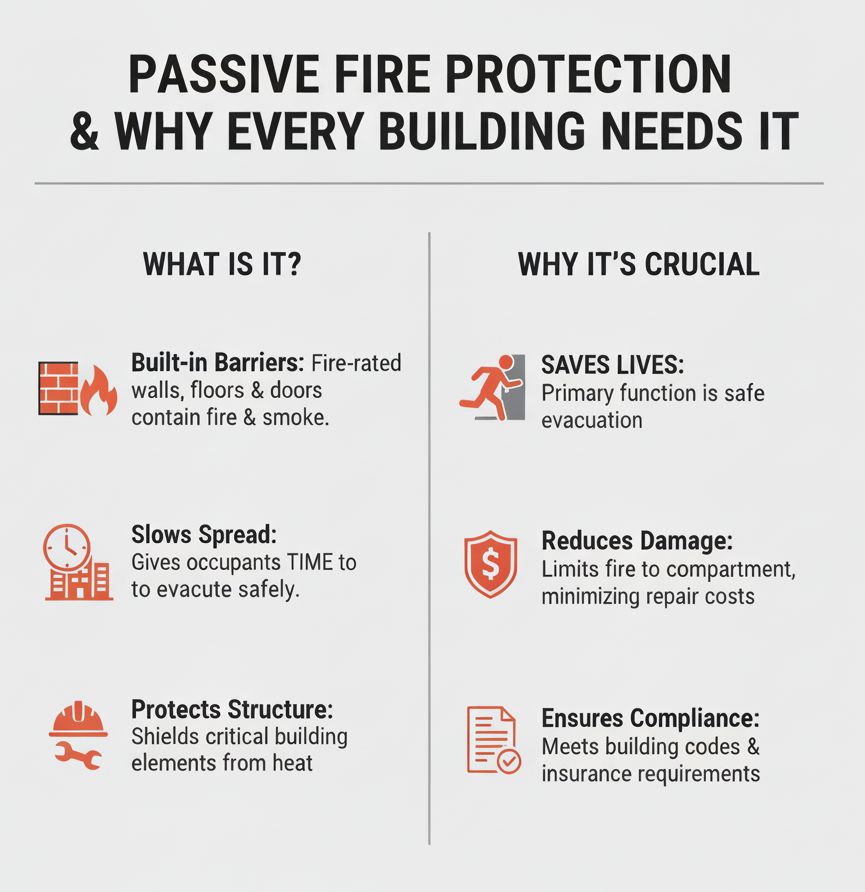
Key Reasons Every Building Needs Passive Fire Protection
Life Safety
When a fire breaks out, every second counts. Passive fire protection is designed to contain the spread of heat, smoke, and flames, keeping evacuation routes like stairwells and corridors, safe for longer.
By dividing a building into fire-resistant compartments, it ensures that occupants have more time to escape and firefighters have safer access. According to Fire & Rescue NSW, smoke inhalation remains the leading cause of fire-related fatalities, highlighting the importance of sealed compartments and smoke barriers that can maintain breathable air conditions during an emergency.
Structural Integrity
Fire doesn’t just damage contents, it attacks the very framework of a building. Structural steel can lose up to 50% of its load-bearing strength at around 550 °C, which can lead to catastrophic collapse.
Passive fire systems, such as fire-rated walls, slabs, cladding, and intumescent coatings, provide essential insulation that slows this process. These systems are engineered and tested under AS 1530.4 and AS 4100 to preserve structural performance long enough for safe evacuation and fire suppression. In multi-storey buildings, this can be the difference between partial damage and total loss.
According to the CSIRO Fire Technology Centre, these treatments can provide 30 – 240 minutes of fire resistance depending on design.
Regulatory Compliance
Passive fire protection is not optional, it’s a legal requirement under the National Construction Code (NCC) and AS 4072.1 – 2005.
These standards specify how fire-resistant elements must be designed, installed, and maintained to achieve a compliant Fire Resistance Level (FRL). Councils and certifiers require evidence that passive fire systems are compliant before issuing or renewing an Annual Fire Safety Statement (AFSS).
Failure to comply can result in fines up to $110,000 for corporations and $22,000 for individuals under the NSW Environmental Planning and Assessment Act 1979. More importantly, non-compliance exposes owners to serious liability if a fire occurs.
Insurance Validity
Insurance companies are increasingly scrutinising fire safety documentation. If your building’s fire systems, including passive components are found to be non-compliant, your insurer can deny claims for property damage or business interruption.
The Insurance Council of Australia (ICA) has stated that “compliance with all statutory fire safety requirements is a condition precedent to coverage” in many policies. Maintaining up-to-date certification of fire-rated walls, doors, and penetrations helps safeguard against coverage disputes and protects financial continuity after a fire event.
Asset Protection
Beyond protecting lives, passive fire protection protects investments. By isolating a fire to its origin zone, it prevents rapid escalation and limits damage to unaffected areas.
This containment reduces repair costs, downtime, and environmental contamination from smoke and water damage. For asset owners, especially those managing high-value or multi-tenanted properties, effective passive fire protection supports operational resilience and faster return to business continuity following an incident.
Legal Protection
In the aftermath of a fire, investigations often focus on whether building owners took “every reasonable step” to ensure safety and compliance. Demonstrating that passive fire systems were properly designed, installed, and maintained can be a powerful legal safeguard.
Comprehensive documentation including inspection records, certification reports, and maintenance logs, provides evidence of due diligence. Courts and regulators look favourably on owners who can prove proactive management of fire safety measures. Conversely, if passive systems are found defective or uncertified, owners, directors, and facility managers can face personal liability, including prosecution or reputational damage.
Ready To Discuss Your Requirements?
Our Experts Look Forward To Hearing From You!
Australian Standards & Regulations For Passive Fire Protection
Australia’s fire protection requirements are primarily governed by the National Construction Code (NCC) and key standards issued by Standards Australia.
For passive systems, compliance often intersects multiple standards:
| Standard | Title | Key Coverage |
| AS 4072.1 – 2005 | Components for Fire-Resistant Construction | Penetration sealing and joint systems |
| AS 1530 Series | Fire Tests on Building Materials | Fire resistance, smoke control, combustibility |
| AS 1905.1 – 2015 | Fire-Resistant Doorsets | Construction, testing, and tagging |
| AS/NZS 1668.1 – 2015 | Fire & Smoke Control in Buildings | Air-handling, smoke exhaust, and dampers |
| NCC Volume 1 – Section E1 | Fire-Resistance & Stability | Fire separation, exits, materials, FRLs |
| AS 1851 – 2012 | Routine Service of Fire Protection Systems | Ongoing maintenance requirements |
Failure to comply can trigger enforcement action under the Environmental Planning and Assessment Regulation 2021 (NSW), including fines of up to $110,000 for corporations and $22,000 for individuals.
Common Weak Points In Building Compliance
Through inspections across NSW, up to 45% of buildings fail their Annual Fire Safety Statement (AFSS) on the first inspection, often due to overlooked passive elements, according to NSW Council Annual Reports in 2023.
The most common non-compliances include:
- Missing or damaged fire door tags
- Unsealed cable or pipe penetrations
- Fire dampers obstructed or painted over
- Illegible FRL markings on walls or shafts
- Inaccessible fire-rated service risers
- Poor documentation or inspection records
These issues don’t just breach compliance, they can void insurance or lead to criminal liability if a fire occurs.
How Passive Fire Protection Saves Lives & Property
The most compelling argument for passive fire prtotection (PFP) is evidence.
Studies by the CSIRO and the Fire Protection Association Australia (FPAA) show that buildings with compliant compartmentation experience up to 70% less structural damage and 60% fewer fatalities in major fire events compared to unprotected ones.
Case Study: The Bankstown Apartment Fire (2012)
In the 2012 Bankstown unit fire, one occupant died and five were injured. Investigators found fire-rated separation had been compromised by unsealed penetrations, allowing smoke and heat to spread rapidly between levels, according to reports from the NSW Coroners Court.
The key insight here is that even a single missing seal can undermine an entire fire-resistance barrier. Passive fire elements are the last line of defence when active systems fail or become overwhelmed.
Insurance & Legal Implications
Fire safety compliance isn’t just about protecting people, it’s also about protecting your legal and financial standing.
Insurance Impacts
- Non-compliance = non-coverage: Many insurers, including the Insurance Council of Australia (ICA), have confirmed that non-compliant fire systems can invalidate property claims after a fire event
- Premium impacts: Buildings that can demonstrate regular maintenance and certification of passive systems often qualify for lower premiums due to reduced risk profiles.
Legal Liability
Under the Environmental Planning & Assessment Act 1979 (NSW), property owners, building managers, and certifiers share responsibility for maintaining fire safety measures.
If a fire causes injury and the investigation finds passive systems were neglected, directors can be held personally liable.
Modern Advances & Testing
While traditional fire-rated walls and sealants remain essential, modern materials and testing techniques are improving resilience and sustainability.
Intumescent Coatings
These paints swell under heat, forming an insulating char that protects steel and structural elements. New water-based formulas now meet AS 1530.4 – 2014 with lower environmental impact.
Fire-Rated Glass & Glazing Systems
Advances in multi-layer laminated glazing allow for fire-resistant transparency, combining aesthetics with safety.
Digital Asset Records
Building managers increasingly use digital AFSS records and BIM (Building Information Modelling) to map fire compartments, seal locations, and certification data, reducing audit errors and simplifying compliance.
Ensuring Compliance – What Property Owners Should Do
Achieving compliance isn’t a one-off exercise. It’s an ongoing process of inspection, documentation and maintenance.
Step 1 – Conduct a Passive Fire Audit
Engage an accredited fire safety practitioner to inspect:
- Fire-rated walls, ceilings, and risers
- Door tags and seals
- Penetration and joint seals
- Damper and ductwork integrity
- Fireproof coatings and cable wraps
Step 2 – Repair & Rectify Defects
Replace damaged seals, re-tag doors, and document all repairs in accordance with AS 1851 – 2012 service schedules.
Step 3 – Maintain Documentation
Maintain an up-to-date Fire Safety Schedule and Annual Fire Safety Statement (AFSS).
Records must be accessible to council inspectors, insurers, and auditors.
Step 4 – Integrate with Broader Fire Strategy
Ensure passive measures complement your active fire protection — from alarm zones to evacuation routes and sprinkler layouts.
Step 5 – Engage Qualified Professionals
Only engage FPAA-accredited practitioners or NSW Fire Safety Assessors approved under the Fire Protection Accreditation Scheme (FPAS).
Ready To Discuss Your Requirements?
Our Experts Look Forward To Hearing From You!
How Essential Asset & Fire Can Help
At Essential Asset & Fire, we help property owners, strata managers, and facility operators meet their passive fire protection obligations through a comprehensive, compliant and cost-efficient process.
Our Services Include:
- Passive Fire Audits & Reports
- Fire Door Inspections & Tagging
- Penetration & Fire Stopping Sealing
- Fire-Rated Coating & Structural Protection
- Documentation & Annual Certification (AFSS)
- Rectification Works & Maintenance Scheduling
- Integration with Active Fire Systems
We provide traceable documentation, photo records, and compliance evidence aligned with AS 4072.1, AS 1530, and NCC Volume 1 E1.
If you’re unsure whether your building meets current fire-resistance standards, our experts can conduct a full compliance audit and report any remedial actions before they become costly problems.
Final Thoughts
Passive fire protection is the silent safeguard of every safe building. While alarms alert and sprinklers fight, it’s passive systems that quietly keep fire and smoke contained, protecting lives, property, and your legal responsibilities.
In an era of increasing regulatory enforcement and insurer scrutiny, non-compliance is not an option. Whether you manage a high-rise, warehouse, or commercial complex, ensuring your passive fire systems are certified and maintained is both a moral and financial imperative.
Frequently Asked Questions (FAQ)
A: Passive fire protection (PFP) refers to the built-in fire safety features that contain and control the spread of fire and smoke. Unlike active systems (such as sprinklers or alarms), PFP works continuously through fire-rated walls, doors, ceilings and sealants, to compartmentalise a building, maintain escape routes, and protect its structure until emergency services arrive.
A: Yes, under the National Construction Code (NCC) and related standards such as AS 4072.1 and AS 1530 series, all buildings must include passive fire measures that achieve a compliant Fire Resistance Level (FRL). Councils require these systems to be maintained and certified annually through an Annual Fire Safety Statement (AFSS).
A: Active systems respond to a fire (e.g., sprinklers), while passive systems contain it (e.g., fire-rated walls, doors, and sealants).
A: At least annually, as part of the Annual Fire Safety Statement (AFSS) process required by NSW councils. Regular spot checks are also recommended after any renovation or service works.
A: Yes, even drilling a hole through a fire-rated wall or trimming a fire door voids its certification unless properly resealed or re-certified.
A: Only accredited practitioners (fire safety) recognised under the FPAA Fire Protection Accreditation Scheme or state-approved equivalent.
A: You risk fines up to $110,000, insurance claim rejection, or legal liability if fire spreads causing injury or loss.
A: No, Only accredited fire safety practitioners under the FPAA Fire Protection Accreditation Scheme (FPAS) or state-recognised equivalent can install, repair, or certify passive fire systems. DIY repairs or uncertified works are considered non-compliant and can invalidate your building’s fire safety statement or insurance coverage.
A: No, even older buildings are subject to the same minimum fire safety obligations under state legislation. Where full upgrades aren’t practical, performance-based solutions can be developed by fire engineers to bring the building to an equivalent level of safety without full reconstruction.
GET IN TOUCH
Schedule A FREE Discovery Call
Important Disclaimer: This article is general in nature and does not constitute legal or building compliance advice. Always consult a licensed fire safety practitioner and review relevant legislation for your property classification.
References:

Fire Extinguisher Servicing Requirements In Australia

Fire Safety Certification in Australia

Request a Free Quote
Get a no-obligation quote today—fast, easy, and completely free!