


How Smart Fire Protection Technology Is Changing Compliance
Quick Summary
Fire protection is no longer just about sprinklers, fire doors, and alarms. Smart fire protection technology is reshaping compliance in Australia, improving safety, streamlining audits, cutting costs and helping property owners stay compliant. In this article, we investigate the technologies, benefits, challenges and recommended implementation approach.
Table Of Contents
In an era of rapid digitisation and increased regulatory scrutiny, fire safety is no longer “set and forget.” Today, building owners and facility managers need intelligence, traceability and automation to stay ahead of fire risks as well as regulatory compliance…
Why Fire Safety Compliance Is Becoming More Demanding
Before exploring technology, it’s important to understand why compliance demands are increasing. That context helps show why innovation is urgent, not just optional.
Regulatory & Standards Reform
- In New South Wales, the NSW Building Commission fire safety reforms are tightening certification, accreditation, and audit requirements for fire safety systems (e.g. requiring “accredited persons” to sign off certain fire safety measures).
- Australia-wide, updates to the National Construction Code (NCC), fire safety standards (e.g. AS 1851 for maintenance, AS 2419.1 for fire hydrant systems) and state/territory fire laws, demand higher assurance of performance.
- Insurers and regulators increasingly expect more than “minimum compliance”, they expect documented proof, traceability and evidence of active monitoring.
Complex Assets, Mixed Use & Integration
Modern buildings are multifunctional, combining retail, commercial offices, residential, data centres, car parks, with overlapping fire loads, compartmentation, and services. Traditional siloed fire systems are often insufficient for these complex interactions.
Stakeholder Risk & Liability
Failures in fire protection don’t just carry immediate safety risk, they carry legal, reputational and financial risk. In litigation or insurance claims, the question often becomes: “Did the owner take every reasonable step to monitor and maintain?” Smart systems can provide the audit trail.
Retrofits & Aging Infrastructure
Many existing buildings were built before modern compliance regimes. Retrofitting smart systems can provide efficient pathways to raise safety and compliance aligned with FPAA Good Practice Guidelines, without full rebuilds.
In short, compliance is today about ongoing performance, data, and accountability, not just ticking boxes. Smart technology is how we bridge from “static compliance” to “active assurance.”
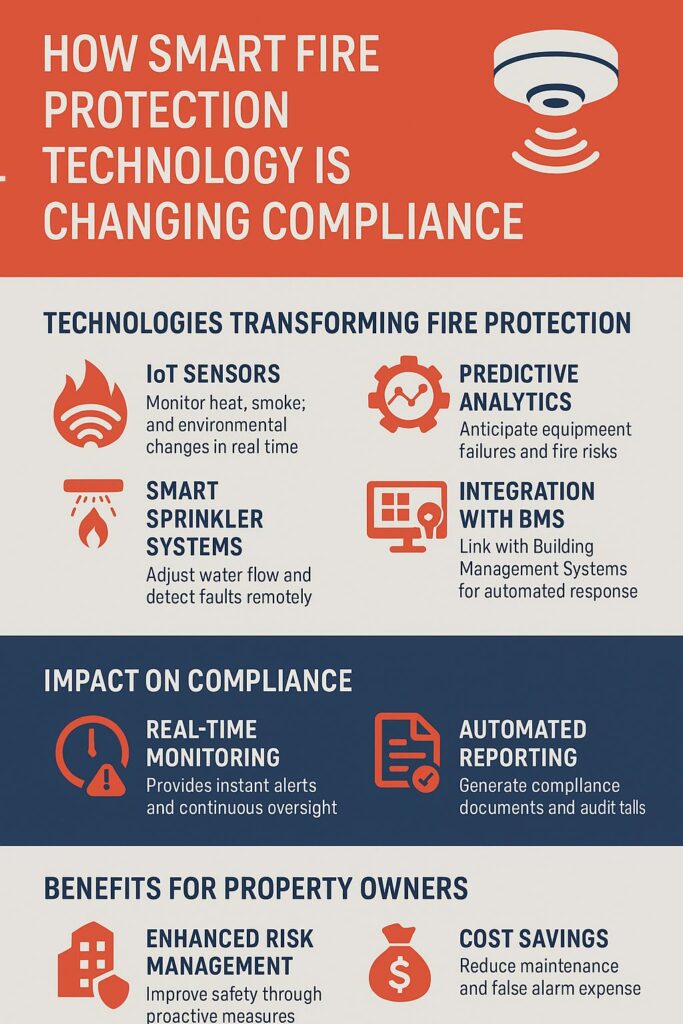
Key Smart Fire Protection Technologies
The table below contains a summary of the leading technologies that are driving this transformation and how they relate to compliance.
| Technology | What It Does | Compliance / Assurance Value |
| IoT Sensors (heat, smoke, gas, structural) | Continuous real-time sensing of environmental changes | Instant alerts, remote oversight, early-warning, audit logs |
| Addressable & Networked Alarms | Each detector has identity & status; networked comms | Precise fault diagnosis, fault tracking, zone isolation |
| Wireless Fire System Components | Uses wireless comms for detectors, panels, actuators | Easier retrofits, redundant paths, less wiring cost |
| Smart Sprinkler & Suppression Systems | Sprinkler zones that can adapt, variable flow, monitored | Fault conditions signalled, water-use feedback, remote control |
| Predictive Maintenance & Analytics | Data-driven forecasts of component failure | Preventive servicing, condition-based interventions |
| Building Information Modelling (BIM) + Digital Twin | 3D models and real-time digital replica of the building | Fire simulations, scenario testing, “as-built” reference |
| Emergency Lighting + IoT Integration | Embedding comms in emergency lighting infrastructure (e.g. using LoRa, LoRaWAN) | Multi-purpose network backbone, remote diagnostics, failover paths |
| Integration with Building Management Systems (BMS) | Fire systems tied into HVAC, access control, power, etc. | Coordinated response (e.g. shutting HVAC, unlocking doors) |
| AI / Machine Learning Detection | Intelligent differentiation of smoke, flame, risk, false alarms | Better sensitivity, fewer nuisance false triggers |
| Cybersecurity Hardened Fire Systems | Securing communication paths, encryption, intrusion detection | Protects integrity of fire safety systems in digital age |
Lets look at a few of these key technologies and concepts in more depth.
IoT Sensors & Connectivity
One of the simplest but most powerful changes, is embedding sensors (for heat, smoke, CO, structural stress) and linking them to networks that monitor continuously. Instead of periodic inspections, you can have real-time visibility of fire risk zones, detect early heat anomalies, or alarm thresholds well before a fire escalates.
Such sensors often feed data into dashboards, alert systems, and automated responses (e.g. send technician, isolate zone, or initiate suppression). Many systems also store logs for compliance checks.
Predictive Maintenance & Analytics
Rather than waiting for annual inspections to catch failures, advanced systems apply analytics to historical and real-time data to predict when a part (detector, sprinkler head, valve, actuator) is likely to fail or degrade. That lets you service just in time, reducing downtime, avoiding surprise faults, and maintaining compliance continuously.
Building Information Modelling (BIM) & Digital Twin
By creating a digital twin (a living, real-time virtual model) of your building, you can simulate fire scenarios, stress-test changes, and monitor system performance in a spatial context. It becomes easier to manage compliance, schedule changes, and understand system interdependencies.
Building Management System (BMS) Integration & Automated Response
A smart fire system doesn’t live in isolation. Integrating it with your building’s management systems enables coordinated action. For example, shutting down HVAC ducts to limit smoke spread, unlocking doors for safe evacuation, or sending alerts to building managers.
Emergency Lighting As IoT Backbone
An interesting innovation, embedding wireless communication modules (e.g. LoRa) into emergency lighting fixtures, can turn them into part of a distributed network. This dual use means less additional hardware and a path to retrofitting connectivity in existing buildings. In Sydney, such deployments have run successfully for years.
Ready To Discuss Your Requirements?
Our Experts Look Forward To Hearing From You!
How Smart Technology Is Helping With Compliance
It’s one thing to adopt smart fire tech, but it’s another to make it compliant (or even compliance-enabling). Here’s how technology is influencing compliance regimes.
1. Real-Time Logging & Audit Trails
One of the biggest compliance gaps in traditional systems is that you only know about system issues when inspections or tests are done (often quarterly or annually). Smart systems generate logs 24/7, creating verifiable audit trails, providing critical evidence aligned with NSW EP&A Regulations. That kind of traceability provides is gold in compliance audits, regulatory reviews, or insurance claims.
2. Automated Reporting & Dashboards
Some systems allow auto-generation of compliance reports (e.g. for AS 1851 inspection results, fault logs) or export to formats regulators accept. Rather than manually compiling data from disparate systems, automation enables less laborious and less error-prone data collection.
3. Fault & Anomaly Alerts
Smart systems can detect deviations, e.g. a detector is offline, a suppression valve stuck, repeated false triggers and send immediate alerts rather than waiting until statutory inspections. By acting early, you reduce noncompliance risk.
4. Compliance By Design With Performance Based Engineering
Modern standards often allow performance-based compliance, demonstrating that your fire system design meets safety outcomes, rather than merely ticking prescriptive boxes. Smart systems provide the measurement and validation data needed to support such performance-based claims.
5. Remote Certification & Inspections
In some advanced systems, accredited professionals can review system health remotely, verify logs, and sign off on compliance certificates without always needing a site visit. This capability is increasingly valued in large or dispersed portfolios.
6. Integration With Accreditation & Regulation
As new laws in NSW and other states require accredited practitioners to certify fire safety measures and performance reports, smart systems make it easier for those professionals to satisfy their evidentiary burden (i.e. having the data, logs, sensor history).
Benefits & Use Cases for Property Owners
Why invest in smart fire protection? Let’s look at tangible advantages and some illustrative examples.
1. Proactive Risk Reduction
- Early detection means less damage, earlier intervention, and lower escalation risk
- You avoid blackouts or system downtime by catching failure modes in advance
2. Cost Efficiency Over Time
- Smarter maintenance schedules reduce wasted effort and minimise expensive emergency fixes
- Lower insurance premiums may become possible when you can show better risk management and live system data
- Reduced liability and better compliance posture
3. Streamlined Compliance & Audits
- Less manual effort to prepare reports, logs, and maintenance records
- Easier to satisfy auditors or regulators as data is ready and traceable
- Support for multi-site portfolios under a unified dashboard
4. Enhanced Tenant Confidence & Market Differentiation
- Demonstrating you use next-gen safety tech can improve tenant confidence, property valuation, and marketing positioning
- You stay ahead of emerging compliance changes (2025 reforms in NSW, etc.)
5. Retrofit Opportunities & Flexibility
- Wireless and modular systems make it easier to upgrade older assets
- You can scale systems or reconfigure as building use changes (e.g. convert spaces)
- Integration with future tech (e.g. AI, augmented reality inspections)
Use Case: Commercial Office Tower
Imagine a 20-floor commercial office tower in Sydney. The building has conventional fire alarms, sprinklers, fire doors, and compliance logs. The owner decides to retrofit with smart detectors, predictive analytics, and integration with the building management system (BMS).
- Each detector now reports status and self-checks
- A dashboard shows trends and component health
- A valve fault on Level 15 triggers an alert; a technician is dispatched before it becomes a noncompliance issue
- During the annual audit, instead of gathering paper records from multiple providers, the owner exports logs and presents historical data showing zero major faults
The compliance burden is reduced, safety is improved, and owners get a “future-ready” fire system.
Ready To Discuss Your Requirements?
Our Experts Look Forward To Hearing From You!
Challenges, Risks & What To Watch For
Smart fire tech is powerful, but it also introduces new complexities. It’s important to be realistic about what to anticipate and how to manage those risks.
1. Cybersecurity & System Integrity
Once fire systems are networked, they become subject to the same cyber risks faced by all integrated networked computer systems. Unauthorised access, malware, network outages etc. Implementing cybersecurity policies such as those outlined by the Australian Signals Directorate, technology, redundancy, encryption and a robust update capability is critical.
2. Interoperability & Standards
Different vendors might have proprietary protocols. Ensuring interoperability (detectors, panels, BMS) and standard communication protocols is key to avoiding lock-in.
3. Regulatory & Standards Acceptance Lag
Standards bodies or regulators may lag behind technology. Some smart features may not yet be officially accepted or may require special approval or justification under performance-based design.
4. Initial Investment & ROI Uncertainty
Smart systems often have higher upfront costs (sensors, network, software). Owners must evaluate RO, while long-term savings or risk reduction justify the investment, short-term budgeting may resist it.
5. Maintenance of the Smart Layer
The “smart” layer (software, connectivity, analytics) itself must be maintained, patched, and monitored. This is a new discipline that requires IT, cybersecurity, and operational alignment.
6. Redundancy & Fail-Safe Modes
If smart components or networks fail, fire systems must degrade gracefully or fall back to safe modes. Designing for fault tolerance is essential.
How to Implement Smart Fire Protection
Stepping from concept to reality requires a careful roadmap. Below is a suggested step-by-step process for property owners.
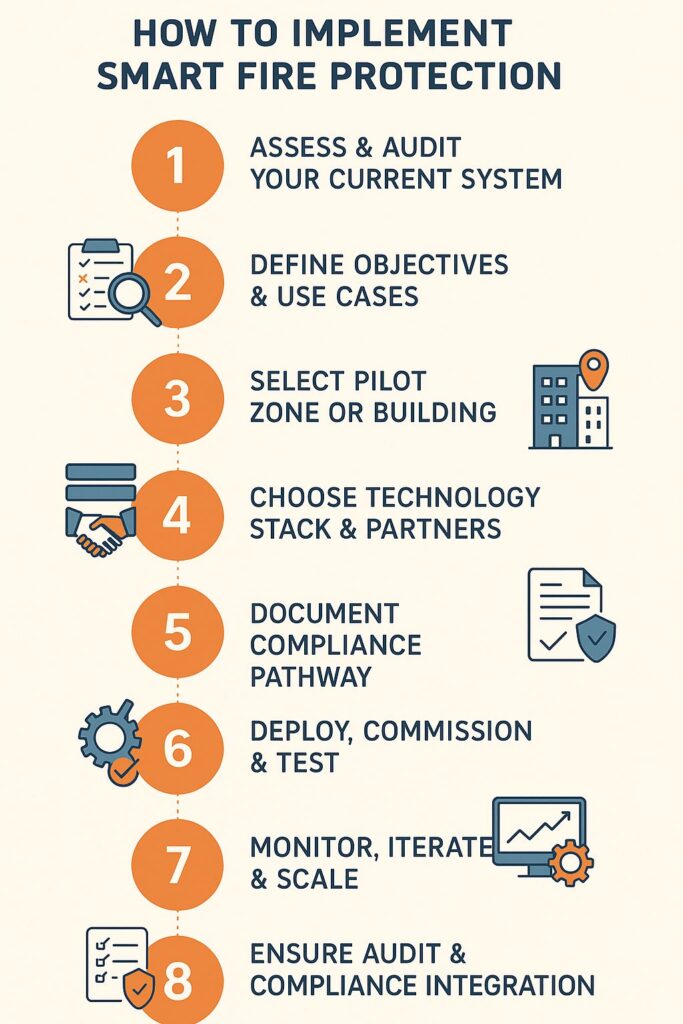
1. Assess & Audit Your Current System
- Map all fire systems (alarms, sprinklers, doors, dampers, suppression)
- Identify weak links, detectors without diagnostics, zones without monitoring, manual systems
- Collect current inspection and test logs
2. Define Objectives & Use Cases
Decide what you want to achieve:
- Real-time fault alerting?
- Predictive maintenance?
- Reduction of false alarms?
- Centralised dashboard across multiple sites?
- Integration with BMS, BMS-to-fire coordination?
3. Select Pilot Zone or Building
Start with a pilot (a tower, wing, or critical area) so you can test, learn, and validate performance without full-scale risk.
4. Choose Technology Stack & Partners
- Select vendors with compliance credentials, proven smart fire systems, and integration capabilities
- Insist on open protocols, secure architecture, and scalability
- Engage fire engineers early, especially for performance-based compliance needs
- Ensure cybersecurity review and architecture is integrated into the system design
5. Document Compliance Pathway
- Map how smart features support compliance requirements (e.g. how logs satisfy AS 1851)
- For any non-standard element, prepare performance justifications or expert reports
- Identify how systems will produce audit reports
6. Deploy, Commission & Test
- Commission and test both “smart” and “fallback” modes
- Validate that the system logs, alerts, and responds as expected
- Conduct scenario simulations (fire drills) and system stress tests
- Train staff in new monitoring dashboards, alert protocols, and response procedures
7. Monitor, Iterate & Scale
- Review fault logs, trends, and maintenance actions periodically
- Adjust thresholds, alerts, or predictive models as you gather data
- Expand to additional zones, buildings, or systems incremental
- Regularly patch and maintain the software/network layer
8. Ensure Audit & Compliance Integration
- Include smart system data in your compliance management workflows
- When inspections or audits occur, present dashboard data, logs, and system evidence
- Keep backups, logs, change records, and tamper evidence in case of disputes
Ready To Discuss Your Requirements?
Our Experts Look Forward To Hearing From You!
Our Approach To Implementing Smart Fire Compliance
Essential Asset & Fire is well-positioned to support clients in adopting and managing smart fire protection for compliance through our depth of experience and skills. Below are more details on the services we offer.
1. Consulting & Compliance Strategy
- We help assess your current systems, map compliance requirements (e.g., NSW reforms, AS standards), and define how smart tech can support compliance
- We assist in performance-based design justifications, expert reports, and liaison with regulators
2. Technology Selection & Integration
- We partner with proven smart fire systems vendors, ensuring interoperability, cybersecurity, and future scalability
- We manage integration with Building Management Systems (BMS) and IoT backbone infrastructure
3. Pilot Deployment & Commissioning
- We can run pilot installations in high-impact areas to validate performance and compliance
- Full commissioning, test certification, and fallback mode validation
4. Ongoing Monitoring, Maintenance & Reporting
- We provide dashboards, alerts, trend analytics, fault logs, and compliance reports
- We support predictive maintenance, remote inspection, and audit support
5. Fire Safety Compliance Services
- As a FPAA-accredited practitioner team, we provide essential compliance services, annual fire safety statements, inspections, audits, documentation, and certifications
- We can tie your compliance auditing to your smart system logs, making the annual audit smoother
6. Training & Change Management
- Supporting your operations team to use dashboards, interpret fault alerts, and respond correctly to system events
- Helping embed smart fire safety in your ongoing management processes
By offering this full stack, from strategy to execution, Essential Asset & Fire is not just as a service provider, but a strategic partner capable of future-proofing your safety and compliance.
Final Thoughts
Smart fire protection technology is no longer a “nice to have.” In a landscape of rising regulatory demands, complex building systems, and growing liability, it’s fast becoming essential for property owners to adopt intelligent, connected fire systems.
If you’re ready to explore how to pilot smart fire protection technology, or want an assessment of your current compliance readiness, I invite you to reach out to the team at Essential Asset & Fire. We can help you map your path, run a prototype, and scale your solution, while ensuring you remain fully compliant today and ready for tomorrow.
Frequently Asked Questions (FAQ)
A: Smart fire protection technology refers to intelligent, connected fire safety systems that use IoT sensors, wireless communication, predictive analytics, and digital monitoring to provide real-time visibility and faster response to fire risks. Unlike traditional systems that rely on periodic manual checks, smart systems monitor continuously and create audit trails that support compliance.
A: Smart fire protection systems generate 24/7 logs, automated reports, and fault alerts. This makes it easier to prove compliance with Australian Standards such as AS 1851 (maintenance) and AS 2419.1 (hydrant systems), as well as NSW regulatory reforms. Instead of waiting for annual inspections, issues can be identified and resolved immediately, reducing the risk of non-compliance fines or insurance issues.
A: Yes. While the standards (like AS 1851 and the NCC) don’t prescribe specific smart systems, they allow performance-based compliance. This means smart systems can be used to demonstrate compliance outcomes, provided they are properly documented and certified by an accredited practitioner.
A: Yes. Many smart systems use wireless sensors and modular components, making them suitable for retrofitting into existing buildings without major structural changes. This makes them ideal for older assets looking to meet new compliance standards without full system replacement.
A: In most cases, yes. While upfront installation costs can be higher, property owners often save long-term through reduced emergency repairs, fewer false alarms, lower insurance risk, and streamlined compliance reporting. Many see a return on investment within a few years.
A: No, regular inspections and certifications are still required under Australian law. However, smart systems make inspections easier by providing real-time logs, diagnostics, and automated data. Instead of finding issues during annual testing, problems are flagged immediately, which helps you stay continuously compliant.
GET IN TOUCH
Schedule A FREE Discovery Call
Important Disclaimer: This article is general in nature and does not constitute legal or building compliance advice. Always consult a licensed fire safety practitioner and review relevant legislation for your property classification.
References:

Fire Extinguisher Servicing Requirements In Australia

Fire Safety Certification in Australia

Request a Free Quote
Get a no-obligation quote today—fast, easy, and completely free!